P-4 vs P-5 Security Level: Do You Really Need Micro-Cut?
If you’ve been comparing paper shredders, you’ve probably noticed two numbers showing up over and over in the specs: P-4 and P-5. They look like a small technical detail, but they’re actually the single biggest factor in how secure your shredded documents really are — and they directly affect which shredder is worth your money.
Here’s the short answer: P-4 is a cross-cut security level suitable for most tax documents, bills, and personal paperwork. P-5 is a micro-cut security level that turns paper into much smaller, confetti-like particles, offering a meaningfully higher level of protection for financial records, legal documents, and anything containing a Social Security number. Whether you need P-5 over P-4 depends on exactly what you’re shredding, not on getting the “best” shredder in general.
Below, we break down what these ratings actually mean, how they compare side by side, and how to decide which one fits your situation.
What Do P-4 and P-5 Actually Mean?
Paper shredder security levels come from the DIN 66399 standard, an international classification system that rates shredders from P-1 (least secure) to P-7 (most secure, used for classified government material). The rating is based on the maximum particle size the shredder produces and, at higher levels, the total surface area of each shred.
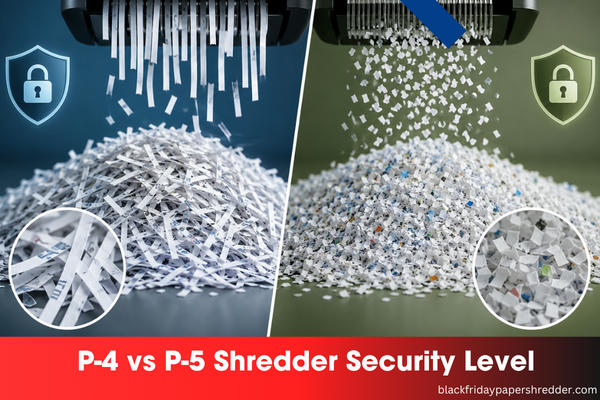
- P-4 is a cross-cut security level. Shredders at this level cut paper into small rectangular pieces, typically no larger than 160 square millimeters per particle.
- P-5 is a micro-cut security level. Shredders at this level cut paper into much smaller particles, generally capped at 30 square millimeters — often described as confetti-cut.
In plain terms: a P-5 shredder produces roughly 5 times smaller particles than a P-4 shredder. That difference matters more than it might sound like, because reconstructing a document from larger cross-cut strips is measurably easier than reconstructing it from micro-cut confetti.
When P-4 Is Genuinely Enough
P-4 is the most common security level recommended for general household and office use, and for good reason — it covers the vast majority of what people actually shred:
- Junk mail and offers with your name and address
- Utility bills and receipts
- Most tax-related paperwork that doesn’t include a full Social Security number or account number
- General business correspondence
- Expired documents that aren’t tied to active financial accounts
If your shredding routine is mostly “keep my mail pile from becoming an identity theft risk,” a good P-4 cross-cut shredder is a reasonable, cost-effective choice — and it’s the level most cross-cut shredders on the market, including popular models from Fellowes, Bonsaii, and Amazon Basics, are built to.
When You Should Step Up to P-5
P-5 micro-cut is worth the extra cost when the documents you’re shredding could cause real financial or legal harm if reconstructed. That includes:
- Full tax returns and IRS correspondence that include your Social Security number
- Bank and investment account statements
- Credit card offers and statements with full account numbers
- Legal documents such as contracts, medical records, or anything with signatures
- Small business records involving client financial data or employee personal information
The logic here is simple: the more damage a reconstructed document could do, the more it’s worth paying for the smaller particle size. For most households, a hybrid approach works well — use a P-4 shredder for routine mail, but consider a P-5 machine (or a shredder that offers a P-5 mode) specifically for tax season and financial document cleanup.
Does P-5 Cost Much More Than P-4?
Generally, yes, but the gap has narrowed. A few years ago, P-5 micro-cut shredders were reserved for premium office models. Today, brands like Bonsaii and Aurora offer P-5 micro-cut shredders at price points close to mid-range P-4 cross-cut machines, especially during Black Friday and Cyber Monday sales when discounts on security-focused shredders tend to be steepest.
If budget is tight, it’s worth checking current Black Friday pricing before assuming P-5 is out of reach — the price difference during the holiday sale season is often smaller than the security upgrade justifies.
Frequently Asked Questions
Is P-5 better than P-4? P-5 offers a higher level of document security than P-4 because it produces smaller particles, making reconstruction significantly harder. It isn’t “better” for every use case, but it’s the stronger choice for sensitive financial and legal documents.
Is P-4 secure enough for tax documents? P-4 is considered a reasonable minimum for tax documents by many security guides, but P-5 is recommended if the document includes a full Social Security number or detailed financial account information.
What’s the difference between cross-cut and micro-cut? Cross-cut shredders (P-4) cut paper into small rectangular pieces, while micro-cut shredders (P-5) cut paper into much smaller, confetti-like particles — roughly five times smaller by area.
Do P-5 shredders take longer to shred paper? Slightly. Because micro-cut shredders make more, smaller cuts per sheet, they can run marginally slower than P-4 cross-cut models, though the difference is minor for typical home or office use.
Can I use a P-4 shredder for everything and skip P-5 entirely? Yes, if you’re mainly shredding general mail, bills, and non-sensitive paperwork. P-4 is not unsafe — it’s simply a lower security tier than P-5, and the right choice depends on what you’re shredding, not on avoiding a “wrong” answer.
Are P-5 shredders harder to find on Amazon? No — P-5 micro-cut shredders are widely available from brands including Bonsaii, Fellowes, and Aurora, and are commonly featured in Black Friday and Cyber Monday paper shredder deals.
Bottom Line
If you’re shredding routine paperwork, a P-4 cross-cut shredder is a solid, budget-friendly choice. If you regularly handle tax documents, bank statements, or anything with a Social Security number, stepping up to a P-5 micro-cut shredder is a worthwhile investment in real identity theft protection — and Black Friday is one of the best times of year to buy one at a lower price.
For a full breakdown of home, office, and heavy-duty shredder categories — plus the biggest expected Black Friday 2026 discounts — see our complete Black Friday paper shredder buying guide.

Hi, I’m Ethan Carter. I research and review paper shredders, compare security levels, and track the best Black Friday deals to help you make smarter buying decisions. My goal is to provide clear, practical, and unbiased guides so you can choose the right shredder with confidence.